- My Cart
0
No items in cart

- My Cart
0
No items in cart
 PCCS pays your UK postage
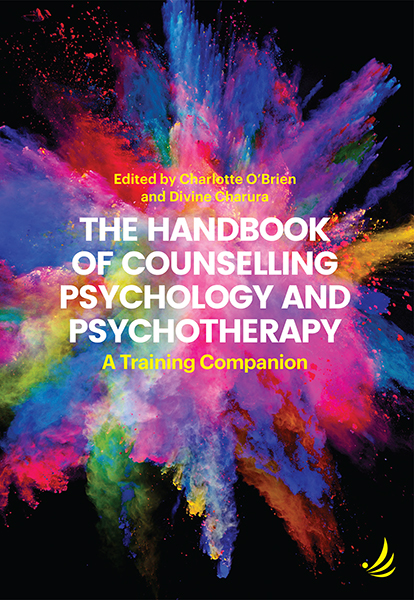
This handbook is a companion for all counselling psychology, psychotherapy and counselling trainees. It will support and guide you as you embark upon your own professional training journey, be that at a foundational or advanced academic level. You are invited to dip in, explore and travel at your own pace throughout the chapters, in an order that supports your own personal, professional, programme or developmental journey. The handbook simplifies, demystifies and explains complex concepts and language, and addresses issues commonly faced by many trainees. Chapters are organised in three sections covering 'the firm foundations', 'the trainee journey', and 'becoming a practitioner and beyond'. Each chapter follows a common structure: an introduction, scope of chapter, exercises or case studies, top takeaways, questions for reflection, recommended reading and key resources for your own further exploration. The exercises and reflective questions are tailored throughout the book to be used independently by trainees, or collectively in the classroom. They can also be used as teaching aids, or as tools to facilitate dialogue and best practice in the therapeutic professions. Chapters are written by educators, therapeutic practitioners, researchers, academic writers, trainees and supervisors, whose diverse and yet collective voices bring many insights and provocations.
The handbook focuses on what unites us as practitioners, while acknowledging the different therapeutic professions of counselling, psychotherapy and counselling psychology. At the heart is recognition that all psychotherapeutic practice is based on a core of relational ethics, love, humanity and a commitment to therapeutic relationships that aim to facilitate transformation, healing, wellbeing or equilibrium. Collectively, the authors encourage all practitioners, whatever their training pathway, to adopt a firm commitment to social justice, inclusive practice, use of a decolonised curriculum, ethical relationships and anti-oppressive leadership in action. These themes run throughout the chapters to set a firm foundation for this book.
Introduction - Charlotte O'Brien and Divine Charura
Section 1: Firm foundations
1 Historical context and development of psychological therapies - Terry Hanley and Laura Anne Winter
2 The relevance of philosophy to therapy practice and research - Byron Al-Murri, Divine Charura, Charlotte O'Brien and John McLeod
3 Developing theoretical fluency - John McLeod, Divine Charura and Charlotte O'Brien
4 Developing an integrative therapeutic practice - Charlotte O'Brien and Divine Charura
5 Developing relational ethics competencies for counselling psychologist and psychotherapist training - Lynne Gabriel and Andrew Reeves
Section 2: The trainee journey
6 Navigating difference, diversity and anti-oppressive practice - Nahid Nasrat and Colin Lago
7 Assessment, formulation and therapeutic engagement - David A. Lane and Sarah Corrie
8 Reading, writing, speaking and finding your voice in therapeutic training - John McLeod
9 Undertaking impactful psychotherapeutic research - Sofie Bager-Charleson, Alistair McBeath, Mary Atito and Alan McPherson
10 Clinical placements, supervision and safeguarding - Ariana Jordan
11 Becoming a reflective practitioner - Charlotte O'Brien and Divine Charura
12 Self-care, personal therapy and practical survival tips - Gerrie Hughes
Section 3: Becoming a practitioner and beyond
13 Professional practice and developing identity as a therapeutic practitioner - Peter Pearce
14 Career pathways and working in different contexts and systems - Emma Bradshaw
15 Navigating accreditation and governance in psychological therapies - Sarah Niblock
16 Personal and professional reflective journeys - Robin Shohet and John Wilson
17 Moving beyond decolonisation of the curriculum in research and practice - Amira-Deka Dirie, Roy Moodley and Keisha Greene
Conclusion - Charlotte O'Brien and Divine Charura
'This handbook stands out for its relatable, inclusive and integrated approach... it bridges the gap between complex psychological theory and compassionate clinical practice. The Editors have assembled a diverse range of voices that match the academic rigour required for professional training with the deeply human element of the therapeutic encounter.'
Professor Emmy van Deurzen, Director, Existential Academy
'This book provides an essential companion for all those undertaking the journey of becoming through immersion in the complex world of therapy. I highly recommend it to all those undertaking training, and also to practitioners who wish to remind themselves of the richness and meaning of our work in the modern world.'
Kate Smith, Professor and Head of Department of Mental Health and Well-being, University of Aberdeen
'The Handbook of Counselling Psychology and Psychotherapy is a perfect companion for those embarking on their counselling psychology journey... I recommend this fantastic resource to those thinking about counselling psychology.'
Dr Brian Murray, Chair, BPS Division of Counselling Psychology
'In this rich compendium, Charlotte O’Brien and Divine Charura bring together an impressive group of leaders in our field... I also applaud the diverse exercises and inclusive questions offered throughout, all geared to stimulating deeper reflection and enhanced social and cultural sensitivity.'
Dr Linda Finlay, Integrative Psychotherapist and Academic Consultant
'The Handbook will be an invaluable resource for trainees, supporting them to critically reflect on their own development as practitioners... it offers an engaging and helpful companion on the often long and stressful journey of training to be a therapist.'
Naomi Moller, Professor of Psychology and Psychotherapy, The Open University
'I am deeply appreciative of how this Handbook positions counselling psychology and psychotherapy as relational, ethical and socially situated practices. It is a thoughtful companion that recognises becoming a practitioner as an ongoing, reflexive and value-laden process... I expect will become a valued resource for trainees, practitioners and educators alike.'
Dr Sue Whitcombe BSc MA DCPsych CPsychol, Counselling Psychologist and Senior Lecturer, Metanoia Institute
'The Handbook of Counselling Psychology and Psychotherapy uses a warm, accessible, and conversational tone, inviting readers to engage closely with the insights of Drs. Charura, O’Brien, and their contributors... it provides one of the most comprehensive introductions to psychotherapeutic practice grounded in relational ethics and a deep commitment to social justice.'
Sophie Yohani, PhD., R Psych. Professor & Counselling Psychology Programs Coordinator, University of Alberta, Canada
Divine Charura MBE is Professor of Counselling Psychology at York St John. University, UK. He is also a counselling psychologist and a coaching psychologist, registered and licenced as a practitioner psychologist with the HCPC. Divine is also an Honorary Fellow of the UKCP and an adult psychotherapist. Divine has co-authored and edited numerous books, including Love and Therapy; Black Identities + White Therapies; The Handbook of Social Justice in Psychological Therapies and Trauma Demystified.

Charlotte O'Brien is Editor-in-Chief for Psychology at Wiley. She is an HCPC registered Counselling Psychologist, BACP registered psychotherapist and Associate Fellow of the BPS. She is a passionate and creative clinician, supervisor, author, educator and researcher, having worked as Programme Director for the Doctorate in Counselling Psychology programme at the University of Manchester, UK and as Training and Education Lead for the BPS Division of Counselling Psychology. Charlotte has a special interest in social justice and the use of anti-discriminatory approaches in psychotherapeutic leadership, training and practice.