- My Cart
0
No items in cart

- My Cart
0
No items in cart
 PCCS pays your UK postage
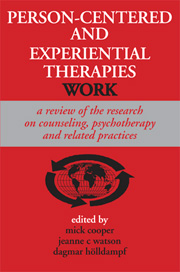
Person-Centered and Experiential Therapies Work provides a comprehensive, systematic and accessible review of the evidence base for the approach and the methods and measures by which it can be evaluated. It gives clear evidence for the effectiveness of person-centered and experiential therapies, and is an essential resource for students and practitioners who want to know more about the empirical support for their work, and to promote it with confidence.
1. The Effectiveness of Person-Centered and Experiential Therapies: A review of the meta-analyses Robert Elliott & Elizabeth Freire
2. Effectiveness of Person-Centered and Experiential Psychotherapies with Children and Young People: A review of outcome studies Dagmar Hölldampf, Michael Behr & Ina Crawford
3. Effectiveness beyond Psychotherapy: The person-centered, experiential paradigm in education, parenting, and management Jeffrey H. D. Cornelius-White & Renate Motschnig-Pitrik
4. Qualitative Meta-Analysis of Outcomes of Person-Centered and Experiential Psychotherapies Ladislav Timulak & Mary Creaner
5. Clients as Active Self-Healers: Implications for the person-centered approach Arthur C. Bohart & Karen Tallman
6. Relating Process to Outcome in Person-Centered and Experiential Psychotherapies: The role of the relationship conditions and clients’ experiencing Jeanne C. Watson, Leslie S. Greenberg & Germain Lieter
7. Operationalizing Incongruence: Measures of self-discrepancy and affect regulation Jeanne C. Watson & Neill Watson
8. Measuring the Relationship Conditions in Person-Centered and Experiential Psychotherapies: Past, present, and future Elizabeth Freire & Soti Grafanaki
9. Researching in a Person-Centered Way Paul Wilkins
10. Key Priorities for Research in the Person-Centered and Experiential Field: ‘If not now, when?’ Mick Cooper, Jeanne C. Watson & Dagmar Hölldampf
I concur with the editors' conclusion that we need to develop and stimulate research, that we need to develop tools and methodologies that are consistent with the fundamental values and principles of the PCE, but that we also need to work on understanding and speaking the language of colleagues from other orientations and disciplines. The challenge for PCE is to produce good quality research that carries credibility and genuinely supports the development of good practice, client choice and empowerment without 'selling out' the principles of the approach by concentrating on symptoms, symptom relief and the economically driven social control agenda of funders, health providers and insurers. Elke Lambers, Person-centered therapist in PCEP Vol 10 Issue 4, 2011
… I suspect the main value of the book to counsellors in healthcare will be to offer (alongside Cooper's Essential Research Findings in Counselling and Psychotherapy: The facts are friendly) supportive evidence for the validity of our work in the terminology recognised and supported by medical and psychological orthodoxy. Ewan Davidson, Person-Centred counsellor in primary care. HCPJ April 2011
Mick Cooper is a Professor of Counselling Psychology at the University of Roehampton, and a practising counselling psychologist. Mick is author of a range of texts on person-centred, existential and pluralistic approaches to counselling and psychotherapy. His principal research interests are counselling in schools and the experience of relational depth.
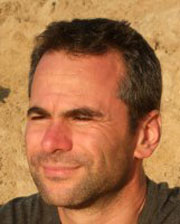
Jeanne Watson is Professor at OISE at the University of Toronto, Canada. A major exponent of humanistic-experiential psychotherapy, she has contributed to the development of Emotion Focused Psychotherapy, the process experiential approach. Dr. Watson teaches and conducts research on the process and outcome of Emotion Focused Psychotherapy and has co-authored and co-edited a total of 7 books and over 65 articles and chapters on the theory and practice of Emotion Focused Psychotherapy, the therapeutic relationship, the alliance, empathy, and emotional expression. Dr. Watson received the Outstanding Early Career Achievement Award from the International Society for Psychotherapy Research in 2002 and was President of the Society in 2014-2015. She has been nominated by her students for supervision and teaching awards, and has a part-time clinical practice in Toronto.
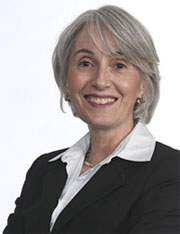
Dagmar Nuding (former Hölldampf) works a lecturer and researcher at the University of Education Schwäbisch Gmünd, Germany. Her main research topic is the effectiveness of person-centered and experiential therapy and counselling with children and adolescents. As lecturer she is involved in the training of teachers, and kindergarten-teachers, she teaches classes in play therapy, person-centered counselling and developmental psychology. As person-centered child and adolescent psychotherapist she mainly works with traumatized children and young people. Dagmar is the editor of the journal „Gesprächspsychotherapie und Personzentrierte Beratung“ (English: Person-Centered therapy and counselling) and belongs to the board of editors of the PERSON. She is a member of the board of the German Association for the person-centered approach. For her research she received the Virginia Axline Junior Award in 2012.